BIOKNOWENG.COM PT / EN
SCIENCE × EDUCATION × KNOWLEDGE
Understand. Connect. Apply.
Online learning and guidance in concept mapping, science and AI with human mediation. For teachers, students, healthcare professionals and lifelong learners.
Try an open learning activity first
Learning pathways
Each pathway starts with your question and develops a product you can explain, revise and justify. Guidance is tailored to your prior knowledge, goals and pace.
More than topics. A network of possibilities.
This map organises the website’s areas. Use the links to reach each section; the drawing is a navigation organiser.
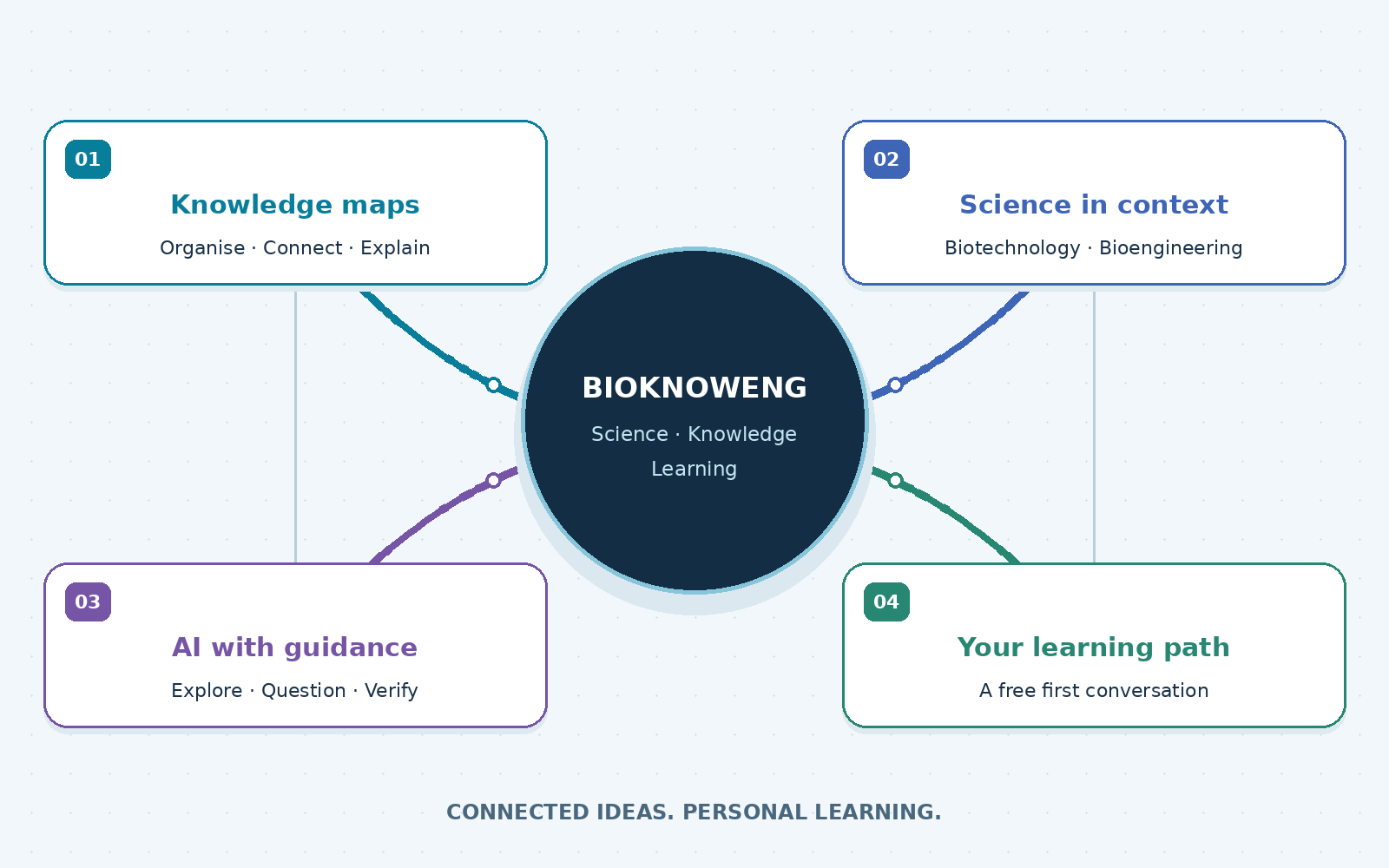
Concept maps · Science in context · AI with human mediation · Medicine · Your learning pathway · Explore further
See how ideas fit together.
Concept maps connect concepts through meaningful linking phrases. Use them to explain your reasoning and review your understanding.
- Teachers: plan a learning activity and examine how students relate concepts.
- Students: organise study and explain relationships in their own words.
- Lifelong learners: investigate a personal or professional question.
- Expected product: a revised map with reasons for the changes.
View the area map and its text summary
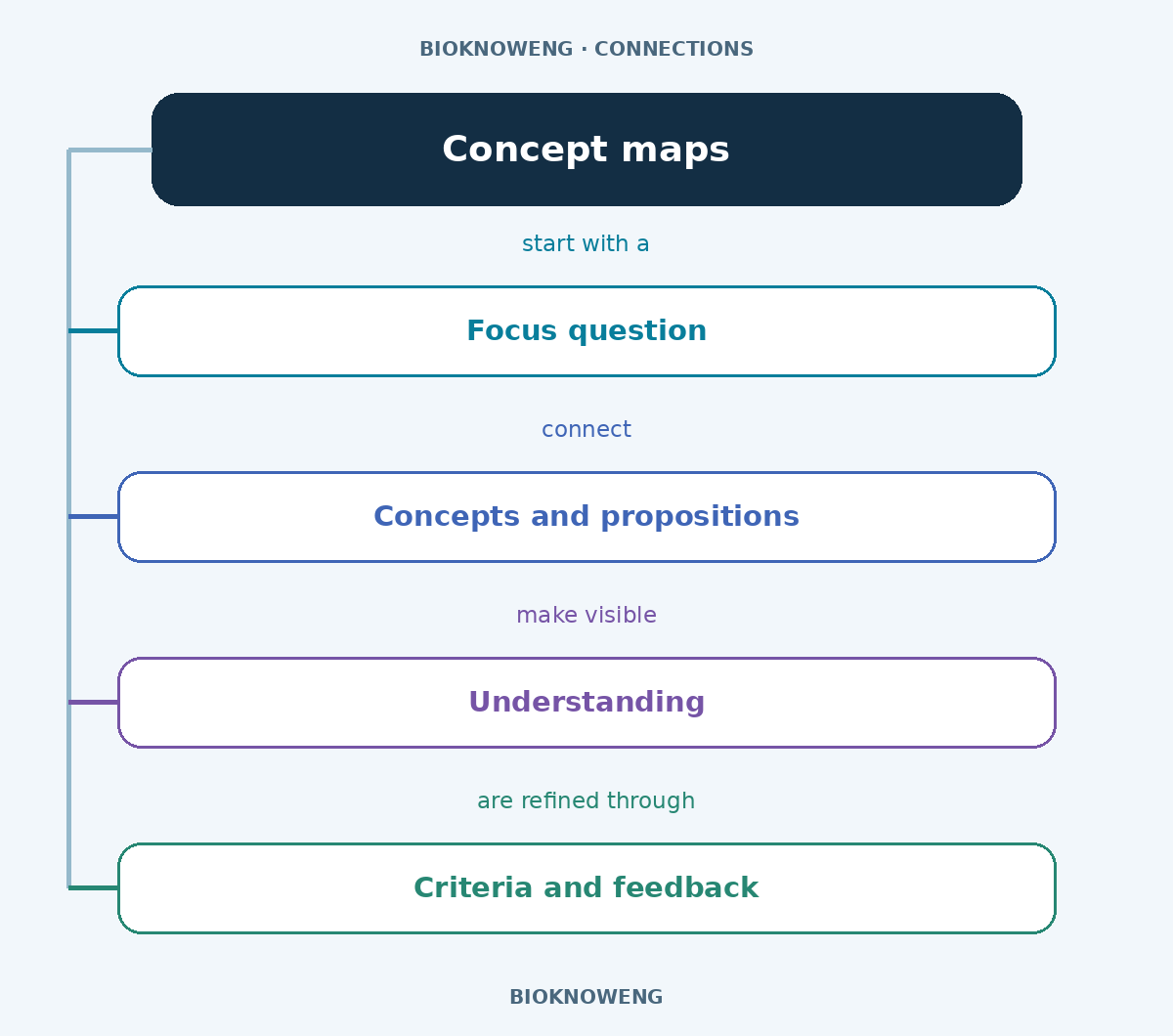
Concept maps → connect concepts through → linking phrases; propositions → make explicit → relationships; revision → helps improve → understanding and justification.
Tools and mapping steps
TOOLS AND PROCESS
Concept maps: tools for learning
Start with a focus question. Select concepts. Add meaningful linking phrases. Explain and revise your map.
Inspired by Ausubel’s meaningful learning and Novak’s concept mapping approach. The scope and format are tailored to your goals.
Mindomo — free for learners when working on assignments provided by the instructor.
CmapTools / CmapCloud — free tools for building concept maps, on a computer or online.
Lucidchart — a free version and educational options, subject to eligibility requirements and the limits of each plan.
The tool is chosen according to each learner’s goals, preferences and access needs. Guidance focuses on the quality of concepts, relationships and reasoning.
Medicine: from concept maps to clinical algorithms
For medical students, family physicians and doctors in hospital specialties who want to make clinical reasoning explicit, organise it and deepen their understanding.
A dialogue-based process — a “ping-pong” between concept maps and clinical algorithms. The map helps explain relationships and the reasoning behind decisions; the algorithm organises steps and decision points. Each revision helps identify gaps, question assumptions and refine both.
AI can support this process through human mediation, source verification and critical review. Materials are intended for education; their use in clinical practice requires appropriate validation and updating.
Expected product: an educational algorithm and a concept map explaining its reasoning, with sources and a revision record. This service supports learning and reasoning; it does not provide medical care.
From living systems to scientific questions.
Biotechnology and biomedical engineering bring together different ways of understanding living systems and their applications. BIOKNOWENG draws on this connection to make scientific ideas accessible and meaningful.
Microbiology
Microorganisms, microbiomes and biofilms.
Bioengineering
Relationships between biology, materials and biomedical applications.
Scientific thinking
Questions, evidence and explanations grounded in science.
View the area map and its text summary
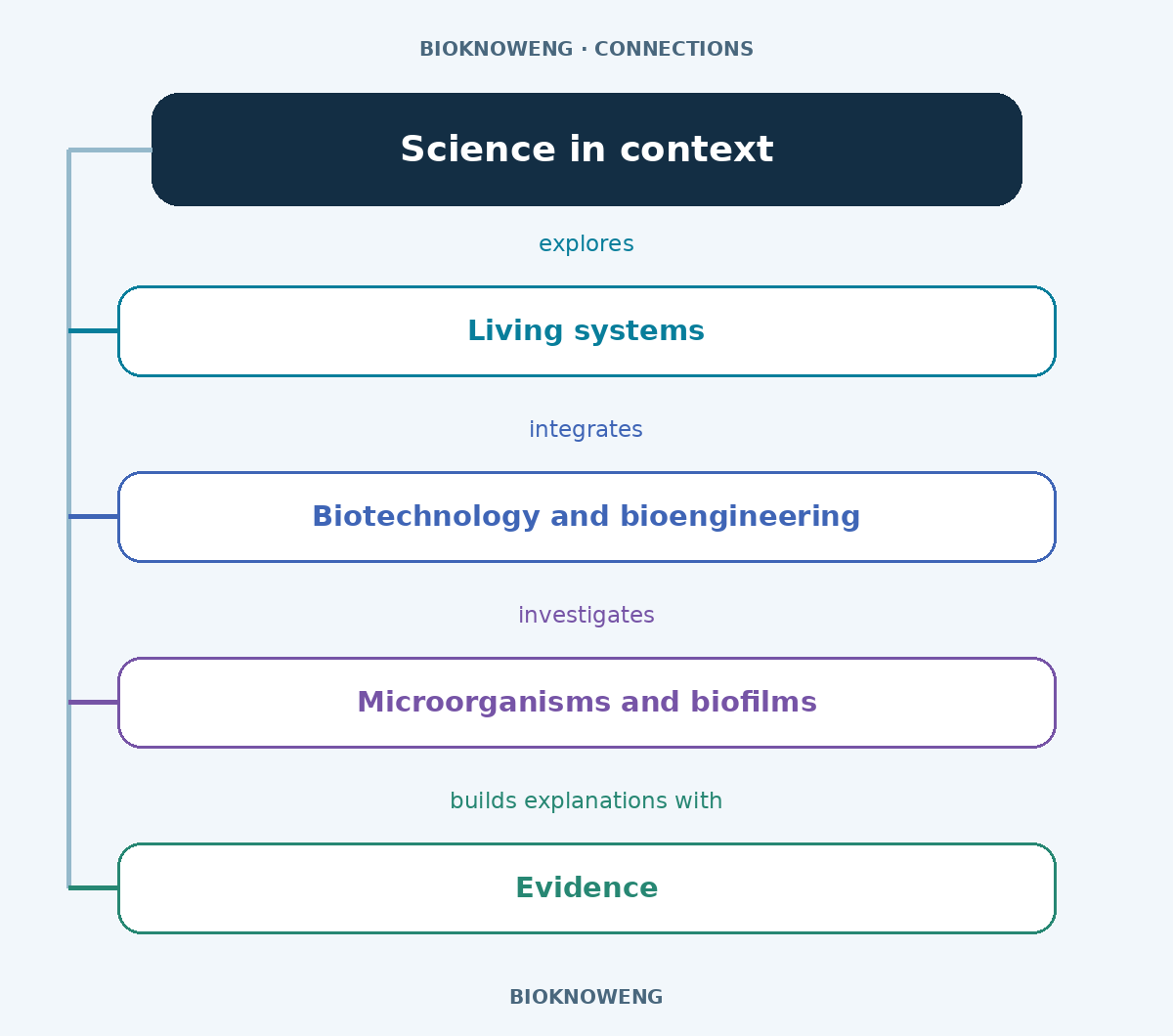
Scientific questions → guide → the search for evidence; biology → studies → living systems; bioengineering → connects → biological knowledge and applications.
ARTIFICIAL INTELLIGENCE
Personalised AI tutors and agents, with teacher mediation.
View the human mediation map
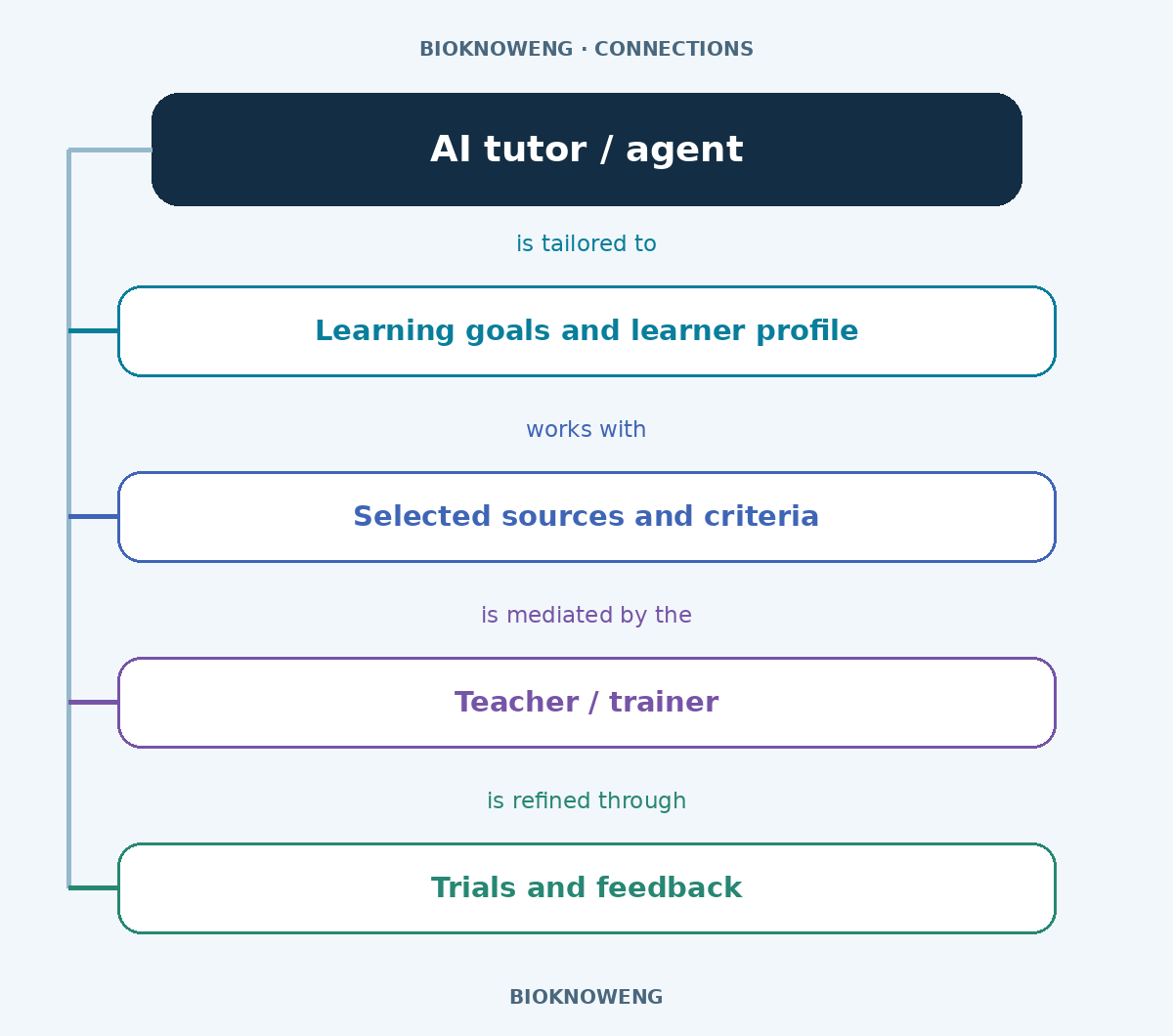
Teacher/trainer → defines → goals and sources; agent → proposes → questions and feedback; learner → explains and revises → their work; teacher/trainer → supervises → the pathway.
BIOKNOWENG proposes the personalised development of AI tutors and agents for specific subjects, learning goals and learner profiles, in collaboration with the teacher or trainer.
Teachers and trainers define the learning goals, select sources and materials, and establish the agent’s pedagogical instructions and feedback criteria. The tutor can ask guiding questions, help connect concepts and support the review of explanations and concept maps.
The teacher or trainer mediates the interaction with the student or trainee: reviewing relevant exchanges, clarifying difficulties and adjusting the learning pathway. The agent supports the learning process; educational decisions and assessment remain with the teacher or trainer.
Each project begins with a discussion of needs, followed by the design of a prototype, a supervised trial and refinement based on feedback. Features, supervision arrangements and data handling are agreed before use.
In school settings and with minors, the project requires teacher/trainer supervision and prior agreement on access, tools and data protection. The agent does not autonomously decide grades or assessment pathways.
Try it: where does puddle water go?
An open activity with no registration or data submission. Use paper or a mapping tool. The dialogue below is illustrative: it represents neither a real student nor a live tutor on this website.
1. Question and starting idea
Which processes can explain a puddle losing water? Before consulting the example, record your explanation and what you observed.
2. Read a sample map
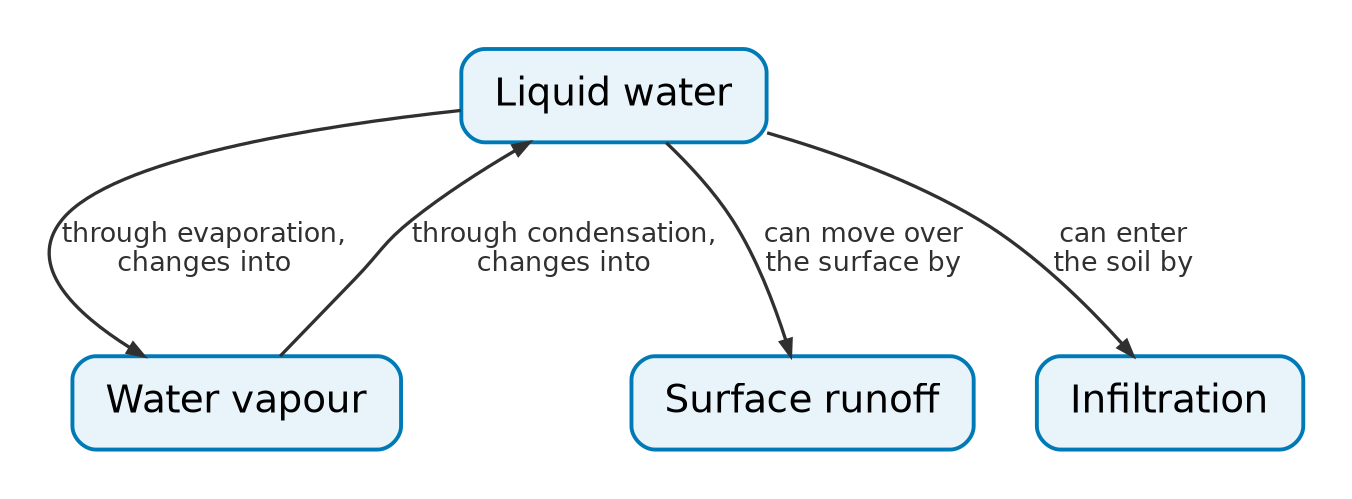
Read the propositions and map annotations
- Liquid water → through evaporation, changes into → water vapour.
- Water vapour → through condensation, changes into → liquid water.
- Liquid water → can move over the surface by → runoff.
- Liquid water → can enter the soil by → infiltration.
- Each box contains one concept; each arrow has a linking phrase. The arrows between water states make the reciprocal relationship explicit. This is a simple model, not a complete map of the water cycle.
3. Question the explanation
Learner: “The puddle got smaller, so all the water evaporated.”
Tutor: “Did you observe evaporation or infer it? Is there a slope, permeable soil or cracks? Which observation could distinguish the processes?”
4. Revise and explain
Add processes consistent with the location to your map. Underline observations and distinguish them from inferences. Explain one change and the evidence supporting it. A shrinking puddle alone cannot quantify each process’s contribution.
Self-assessment and a sample revision
“The water may have evaporated; depending on the surface and location, it may also have run off or infiltrated. I need further observations to compare these hypotheses.”
- Can I read every link as a meaningful sentence?
- Did I separate observations from inferences?
- Did I explain what I changed and why?
Source for checking the processes: USGS — Water Cycle.
How guidance works
The learning support is delivered online, mainly through asynchronous activities: you can explore materials, build maps, interact with the available tutors or agents and submit work at times that suit you. Occasional synchronous meetings with the teacher or trainer are scheduled by agreement to discuss questions, review progress and adjust the learning pathway.
This format enables international participation. The working language, time zones, response times and frequency of live meetings are agreed individually before the programme begins.
- Start: a free introductory conversation to clarify your needs.
- Proposal: goals, output, schedule, tools and terms agreed before starting.
- Work: construction, feedback and revision, mainly asynchronously.
- Completion: explain the product and reflect on changes in understanding.
Explore further
Podcasts and other resources I find stimulating for exploring science, asking questions and deepening knowledge, with curiosity and critical thinking.
Huberman Lab — Andrew Huberman
Conversations about science and its connections with everyday life, across topics including the brain, learning, behaviour, sleep, exercise and well-being. Explore the full podcast and choose the subjects that interest you.
Language: English · Explore Huberman Lab (opens in a new tab)
Lifespan — David Sinclair
Conversations about the biology of ageing and longevity, connecting research with topics such as nutrition, exercise, metabolism and health. Explore the full podcast at your own pace.
Language: English · Explore Lifespan (opens in a new tab)
Brain Inspired — Paul Middlebrooks
In-depth conversations with researchers exploring neuroscience, natural and artificial intelligence, cognition, consciousness and philosophy. Explore the full podcast and the connections between these fields.
Language: English · Explore Brain Inspired (opens in a new tab)
Simplicity, complexity and the responsibility to think
Simplicity requires integrating complexity. Making thinking visible means explaining relationships, checking sources and taking responsibility for decisions about AI outputs.
Read the full editorial and references
EDITORIAL · BIOKNOWENG
The simplicity we seek grows from the work of integrating complexity. Inspired by Edgar Morin, we aim to connect fields of knowledge, recognise contexts and make essential ideas understandable while preserving the relationships that give them meaning.
Gowin’s Vee offers a lens for questioning the world: connecting questions, concepts and assumptions with observations, procedures and evidence. We propose extending this attitude to everyday life, while recognising the place of experience, values and uncertainty.
Learning changes us. Ausubel and Novak help us understand how new knowledge connects with and reorganises cognitive structures. Vygotsky draws attention to language, interaction and social mediation. From this perspective, learning involves thought, emotion and relationships: human development continually reconstructed.
Artificial intelligence expands our possibilities, yet it can also tempt us with a finished product that bypasses the effort of understanding how it was made. Freely drawing on Nietzsche’s image of the abyss, we see a risk of comfortable ignorance: possessing a convincing answer and mistaking it for knowledge. This application to AI is our reflection, not the philosopher’s claim.
Human authenticity becomes visible in the decisions we can explain. Demonstrating critical thinking requires checking sources, comparing evidence, detecting errors, stating uncertainties and justifying what we accept, change or reject. Exercising editorial control over AI means being able to show the process: the starting point, the checks performed, the revisions and the reasons behind the final version.
This is BIOKNOWENG’s commitment: to use maps, inquiry and AI tutors with human mediation to make thinking visible. A finished product gains educational value when the person presenting it can understand it, defend it and take responsibility for what it communicates.
A person behind the learning.
António Pedro Fonseca
Biologist · MSc in Biomedical Engineering · PhD in Human Biology
Founder of BIOKNOWENG, with experience in secondary and higher education, research and training. His work connects microbiology and biofilms with science education, concept mapping, knowledge cartography and artificial intelligence applied to teaching and learning. His interests include the design of personalised AI tutors and agents with teacher or trainer mediation.
Academic profile and publications · ORCID
Tutoring and possible publication of work
Sharing knowledge through publication
Work developed through combined AI and human tutoring may be proposed for submission to scientific or educational publications, subject to the learner’s agreement and explicit, informed consent for that specific purpose, and the anonymisation of personal data and identifying information.
Participation is optional and does not affect access to or assessment within the training. Before any submission, the material to be shared, the anonymisation arrangements and any applicable authorship or acknowledgements will be agreed with the learner. Submission does not guarantee acceptance or publication.
YOUR NEXT STEP
What would you like to understand better?
Tell me what you teach, what you are studying or which challenge you would like to explore. We will start with a free, no-obligation conversation.
Your privacy. Training enquiries are received by email; the feedback form collects opinions about the project. When you write to us, we receive your email address and the information you choose to share so we can reply to your enquiry.
Email → Introductory conversation → A learning proposal tailored to you.
The scope, conditions and any fees are agreed individually after the introductory conversation.
In your first email, the topic and goal are enough. Do not send identifiable clinical information or student data. AI use and the applicable privacy information will be clarified before guidance begins.
Your feedback helps improve this project
Participation is optional. Your rating is received privately and is not displayed publicly. Your comment may only be published with your authorisation and after the site owner’s approval. If you leave the name or pseudonym blank, any published comment will be attributed to “Visitor”.


Responses are received by BIOKNOWENG through WordPress.com/Jetpack Forms to review and improve the project. The platform may process technical data for operation and spam protection. Do not include sensitive data or information about students or patients. For data questions or deletion requests: bioknoweng@gmail.com. Platform privacy.
Back to the knowledge network · PT / EN
BIOKNOWENG · Biotechnology · Bioengineering · Knowledge Cartography · AI

